
The Hail Holy Queen prayer stands as one of the most cherished invocations in Catholic tradition, spoken by millions who turn to Mary in times of need, gratitude, and devotion. This ancient prayer also known as the Salve Regina closes each decade of the rosary and serves as a heartfelt plea to the Mother of Mercy. Whether you’re praying the rosary daily or seeking comfort in difficult moments, understanding this prayer deepens your spiritual connection and brings peace to your heart.
Many Catholics recite the hail holy queen prayer rosary without fully grasping the profound meaning woven into each phrase. This prayer isn’t just words it’s a conversation with Mary, acknowledging both our earthly struggles and our hope for eternal joy. When you pray the hail holy queen full prayer, you’re joining countless believers across centuries who have found solace in Mary’s maternal intercession.
The hail holy queen prayer catholic tradition teaches us to call upon Mary as our advocate, asking her to show us Jesus after this exile on earth. This prayer recognizes our human frailty while affirming our faith in divine mercy. The hail holy queen mother of mercy invocation specifically addresses Mary’s compassionate nature she understands suffering because she stood at the foot of the cross.
Hail Holy Queen Prayer (Complete with Meaning)
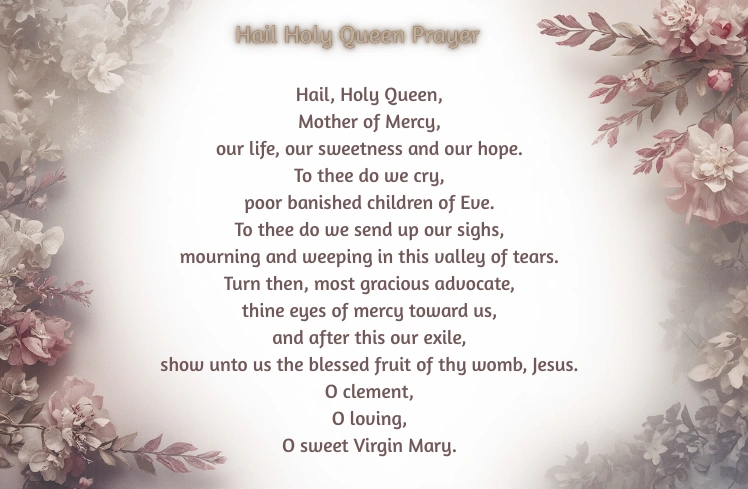
Hail, Holy Queen,
Mother of Mercy,
our life, our sweetness and our hope.
To thee do we cry,
poor banished children of Eve.
To thee do we send up our sighs,
mourning and weeping in this valley of tears.
Turn then, most gracious advocate,
thine eyes of mercy toward us,
and after this our exile,
show unto us the blessed fruit of thy womb, Jesus.
O clement,
O loving,
O sweet Virgin Mary.
Response:
Pray for us, O Holy Mother of God,
That we may be made worthy of the promises of Christ.
Understanding Each Phrase:
“Hail, Holy Queen, Mother of Mercy” – This opening acknowledges Mary’s queenship in heaven and her role as the vessel through which God’s mercy entered the world through Jesus Christ.
“Our life, our sweetness and our hope” – These three titles recognize Mary’s spiritual motherhood. She represents the fullness of life in Christ, the sweetness of God’s love, and the hope of salvation for all believers.
“Poor banished children of Eve” – This phrase acknowledges humanity’s fallen state after Original Sin. We’re described as exiles from Paradise, descended from Eve, living in a world marked by suffering and separation from God’s original plan.
“Valley of tears” – This biblical metaphor (from Psalm 84) describes earthly life as a place of trial, suffering, and temporary sorrow before reaching our eternal home.
“Most gracious advocate” – Mary serves as our intercessor before God, presenting our prayers to her Son. An advocate speaks on behalf of another Mary advocates for humanity before the throne of heaven.
“Thine eyes of mercy toward us” – We ask Mary to look upon us with compassion, understanding our struggles and bringing our needs before Jesus.
“After this our exile, show unto us the blessed fruit of thy womb, Jesus” – The ultimate petition: asking Mary to lead us to eternal union with Christ in heaven after our earthly journey ends.
“O clement, O loving, O sweet Virgin Mary” – These three attributes (merciful, loving, gentle) summarize Mary’s maternal character and her disposition toward those who call upon her.
Read Also: St Gertrude Prayer
Hail Holy Queen Prayer Rosary
The Hail Holy Queen prayer holds a specific position within the rosary structure as the traditional closing prayer after completing all five decades. This placement carries deep theological significance.
When to Pray It During the Rosary:
After finishing the fifth decade (the final set of ten Hail Marys and one Glory Be), Catholics traditionally pray the Hail Holy Queen before the concluding prayers. This creates a natural transition from meditating on the mysteries of Christ’s life to entrusting ourselves to Mary’s maternal care.
Why It Concludes the Rosary:
The rosary takes us through salvation history from the Annunciation through Christ’s Resurrection and beyond. After contemplating these sacred mysteries, we acknowledge that we still live in the “valley of tears” and need Mary’s continued intercession. The Hail Holy Queen shifts focus from past events to our present spiritual needs and future hope.
Proper Rosary Closing Sequence:
- Fifth decade completed (ten Hail Marys, one Glory Be, one Fatima Prayer)
- Hail Holy Queen (Salve Regina)
- Closing prayer: “O God, whose only begotten Son, by His life, death, and resurrection, has purchased for us the rewards of eternal life…”
- Sign of the Cross
Historical Connection:
Pope Pius V officially incorporated the Hail Holy Queen into the rosary prayers in the 16th century, though the practice existed informally long before. This standardization helped unify Catholic prayer practice worldwide.
Meditative Purpose:
As you pray this after the rosary decades, reflect on how the mysteries you just contemplated address the very exile and suffering mentioned in the prayer. Christ’s incarnation, passion, and resurrection provide the answer to our status as “banished children of Eve.”
Hail Holy Queen Full Prayer
The Hail Holy Queen full prayer includes both the main invocation and the versicle-response exchange that follows, creating a complete prayer dialogue between the faithful and God through Mary’s intercession.
Complete Version with Response:
Hail, Holy Queen, Mother of Mercy, our life, our sweetness and our hope. To thee do we cry, poor banished children of Eve. To thee do we send up our sighs, mourning and weeping in this valley of tears. Turn then, most gracious advocate, thine eyes of mercy toward us, and after this our exile, show unto us the blessed fruit of thy womb, Jesus. O clement, O loving, O sweet Virgin Mary.
V. Pray for us, O Holy Mother of God,
R. That we may be made worthy of the promises of Christ.
Let us pray:
O God, whose only begotten Son, by His life, death, and resurrection, has purchased for us the rewards of eternal life; grant, we beseech Thee, that by meditating upon these mysteries of the most holy Rosary of the Blessed Virgin Mary, we may imitate what they contain and obtain what they promise, through the same Christ our Lord. Amen.
The Three-Part Structure:
Part 1: The Main Prayer (Salve Regina) – This is the poetic invocation to Mary that forms the prayer’s heart. It combines praise, petition, and acknowledgment of our human condition.
Part 2: The Versicle and Response – This brief exchange follows the ancient pattern of liturgical prayer, where a leader (V.) makes a statement and the congregation responds (R.). This creates communal participation even in private prayer.
Part 3: The Concluding Collect – This optional but traditional prayer specifically connects the Hail Holy Queen to the rosary mysteries. It asks God to help us “imitate what they contain and obtain what they promise” turning meditation into transformation.
When to Use the Full Version:
The complete three-part prayer appears most commonly after praying the rosary, during Marian devotions, or at the end of Compline (Night Prayer) in the Liturgy of the Hours. Private devotions may use just the main Salve Regina portion, which remains complete and powerful on its own.
Latin Original (Salve Regina):
Salve, Regina, Mater misericordiae, vita, dulcedo, et spes nostra, salve. Ad te clamamus exsules filii Hevae. Ad te suspiramus, gementes et flentes in hac lacrimarum valle. Eia, ergo, advocata nostra, illos tuos misericordes oculos ad nos converte. Et Jesum, benedictum fructum ventris tui, nobis post hoc exilium ostende. O clemens, O pia, O dulcis Virgo Maria.
Hail Holy Queen Prayer Catholic
The Hail Holy Queen prayer represents a cornerstone of Catholic Marian devotion, with roots stretching back to the medieval Church and theological foundations in Sacred Scripture and Tradition.
Official Church Status:
The Catholic Church formally recognizes the Salve Regina as one of the four principal Marian antiphons ancient liturgical hymns dedicated to the Blessed Virgin Mary. The other three are Alma Redemptoris Mater, Ave Regina Caelorum, and Regina Caeli. These antiphons rotate throughout the liturgical year during the Liturgy of the Hours.
Historical Origins:
The prayer dates to the 11th century, with authorship traditionally attributed to Hermann of Reichenau (Hermann Contractus), a Benedictine monk who died in 1054. However, some scholars suggest it may have emerged from earlier monastic traditions. By the 12th century, the Salve Regina had spread throughout European monasteries and cathedrals.
Theological Foundation:
Catholic teaching on this prayer rests on several doctrinal pillars:
Mary’s Queenship – Based on her role as Mother of Christ the King and her Assumption into heaven, the Church affirmed Mary’s queenly dignity. Pope Pius XII established the feast of the Queenship of Mary in 1954, confirming this ancient belief.
Marian Intercession – Catholics believe Mary’s prayers carry special weight before God because of her unique relationship with Christ. She doesn’t grant prayers herself but intercedes with her Son, as she did at the wedding feast of Cana.
Mary as Mother of the Church – The Second Vatican Council (1962-1965) affirmed Mary’s spiritual motherhood over all believers. When Jesus said “Behold your mother” from the cross, he gave Mary to the whole Church, not just to John.
Use in Catholic Liturgy:
The Hail Holy Queen appears in several official Church contexts:
- Divine Office (Liturgy of the Hours): Sung or recited after Compline from Trinity Sunday until Advent
- Rosary: Traditional closing prayer after the five decades
- Benediction: Sometimes included in Eucharistic adoration services
- Marian Devotions: May processions, novenas, and feast day celebrations
Catechism Connection:
The Catechism of the Catholic Church (paragraphs 963-972) explains the theological basis for Marian prayers like the Salve Regina, emphasizing that all Marian devotion ultimately leads to Christ and glorifies the Trinity.
Indulgences:
The Catholic Church grants a partial indulgence for devout recitation of the Hail Holy Queen. An indulgence is a remission of temporal punishment for sins already forgiven, reflecting the prayer’s spiritual value in Church tradition.
Hail Holy Queen Mother of Mercy
The title “Mother of Mercy” represents one of Christianity’s most profound understandings of Mary’s role in salvation history and her ongoing relationship with believers.
Biblical Foundation for “Mother of Mercy”:
Luke 1:46-55 (The Magnificat) – Mary’s song proclaims “His mercy is from age to age to those who fear him.” As the vessel through which Mercy Incarnate (Jesus) entered the world, Mary becomes intrinsically connected to divine mercy.
Luke 1:78-79 – Zechariah’s prophecy speaks of God’s mercy visiting us “to give light to those who sit in darkness,” which was fulfilled through Mary’s yes to bearing Christ.
John 2:1-11 (Wedding at Cana) – Mary’s intercession prompted Jesus’s first miracle. Her compassionate attention to human need demonstrates her merciful heart she notices suffering and brings it to her Son.
John 19:25-27 – Standing at the cross, Mary witnessed the ultimate act of divine mercy Christ’s sacrifice for sinners. Jesus then gave her as a mother to all believers, extending her merciful care beyond her biological son.
Theological Meaning of Mary’s Mercy:
She Bore Mercy Itself – Mary carried Jesus, who is God’s mercy made flesh. Saint Faustina Kowalska, mystic of Divine Mercy, emphasized that Mary is the “Mother of Mercy” because she is the mother of Jesus, who revealed God’s mercy most fully.
She Understands Human Suffering – Mary experienced profound sorrow: fleeing to Egypt, losing Jesus in the temple, and watching her Son’s crucifixion. This firsthand knowledge of pain makes her a merciful intercessor who truly comprehends human anguish.
She Never Refuses Petitions – Catholic tradition holds that Mary’s maternal mercy means she turns no one away. Saint Bernard of Clairvaux famously wrote, “Never was it known that anyone who fled to thy protection, implored thy help, or sought thine intercession was left unaided.”
She Leads Sinners to Conversion – Mary’s mercy extends especially to those furthest from God. Countless conversion stories throughout Church history credit Mary’s gentle intervention with bringing souls back to her Son.
Devotional Practices Honoring Mary as Mother of Mercy:
The Memorare Prayer – Begins “Remember, O most gracious Virgin Mary, that never was it known…” This prayer explicitly invokes Mary’s merciful nature.
Scapular Devotion – The Brown Scapular of Our Lady of Mount Carmel represents Mary’s promise of mercy and protection to those who wear it devoutly.
First Saturday Devotions – Requested by Mary at Fatima, these practices honor her Immaculate Heart and seek her merciful intercession for the conversion of sinners.
Marian Shrines – Places like Lourdes, Fatima, and Guadalupe became centers of healing and mercy after Mary’s appearances, demonstrating her continued maternal care.
How to Call Upon the Mother of Mercy:
In Times of Sin – Approach Mary without fear when you’ve fallen. Her mercy means she desires your return to grace, not your condemnation.
During Illness or Suffering – Mary’s compassion embraces those in pain. Bring your physical and emotional wounds to her, asking her to present them to Jesus.
For Others in Need – Mary’s merciful heart extends to all humanity. Pray to her for family members, friends, or even strangers facing difficulties.
At the Hour of Death – The Hail Mary concludes “pray for us sinners, now and at the hour of our death.” Catholics traditionally invoke Mary’s mercy at life’s end, trusting she will guide souls safely to her Son.
Pope Francis on Mary’s Mercy:
Pope Francis frequently emphasizes Mary as Mother of Mercy, stating: “Mary is the Mother of Mercy, who teaches us how to show mercy…she is the first to experience God’s mercy and compassion.” He established extraordinary Jubilee years focused on Divine Mercy, repeatedly pointing to Mary as the model and mother of merciful love.
The title “Mother of Mercy” isn’t merely poetic it defines Mary’s essential relationship with humanity. Through her, Mercy came into the world. Through her ongoing intercession, mercy continues to flow to all who ask.
Conclusion
The Hail Holy Queen prayer remains a powerful spiritual anchor for Catholics worldwide, offering comfort during trials and expressing devotion to Mary’s maternal care. By praying the hail holy queen prayer rosary with genuine intention, you create a direct line of communication with the Mother of God, asking her to intercede on your behalf before her Son.
Remember that the hail holy queen full prayer works best when spoken from the heart, not merely recited mechanically. Take time to reflect on each phrase, especially when you address the hail holy queen mother of mercy let those words remind you that Mary understands your pain, your fears, and your deepest longings.
The hail holy queen prayer catholic tradition has sustained believers through wars, personal tragedies, and moments of profound joy for over a thousand years. You’re now part of that living tradition. Whether you pray this during your rosary, before bed, or in moments of crisis, Mary hears you.
May this prayer bring you closer to Mary’s loving embrace and guide your steps toward her Son. Return to Blessingread.com whenever you need spiritual nourishment, prayer resources, or encouragement in your faith journey. Your prayers matter, and Mary’s intercession remains constant.
About the Author
Written by: Ravi Kumar, Faith Content Writer with 5+ years of experience creating prayer guides, devotional content, and spiritual reflections that inspire and uplift readers.
? FAQs About the Hail Holy Queen Prayer
What is the Hail Holy Queen prayer word for word?
Hail, Holy Queen, Mother of Mercy, our life, our sweetness and our hope. To thee do we cry, poor banished children of Eve. To thee do we send up our sighs, mourning and weeping in this valley of tears. Turn then, most gracious advocate, thine eyes of mercy toward us, and after this our exile, show unto us the blessed fruit of thy womb, Jesus. O clement, O loving, O sweet Virgin Mary.
When do you say the Hail Holy Queen during the rosary?
Pray it after completing all five decades, right before the final closing prayers. It comes after the last Glory Be and Fatima Prayer of the fifth decade.
Is the Hail Holy Queen prayer in the Bible?
No, it’s not directly quoted in Scripture. The Church developed this 11th-century prayer using biblical themes about Mary and humanity’s fallen state from Luke’s Gospel and the Psalms.
Why do Catholics pray to Mary instead of directly to God?
Catholics ask Mary to intercede, not replace God. It’s like asking a friend to pray for you. Mary brings prayers to Jesus—all Marian prayer ultimately worships God alone.
What does “poor banished children of Eve” mean?
It refers to humanity’s fallen state after Original Sin. We’re “banished” from Paradise, living in a world with suffering and death as Eve’s descendants.
Do you have to say the Hail Holy Queen after the rosary?
It’s traditional but not strictly required. The essential rosary components are the Creed, Our Fathers, Hail Marys, and Glory Bes. This closing prayer has been standard practice for centuries.
What’s the difference between Hail Mary and Hail Holy Queen?
Hail Mary uses Scripture (Luke 1:28, 1:42) and asks for prayers. Hail Holy Queen is a longer medieval prayer acknowledging Mary’s queenship and asking her to lead us to Jesus.
Why is Mary called our “life, sweetness, and hope”?
She’s “life” because she brought Christ into the world. She’s “sweetness” as God’s tender love incarnate. She’s “hope” because she intercedes for our salvation.
