

Serenity prayer has been spoken by millions since the 1930s, and there’s a reason it endures. You’re likely here because life feels overwhelming right now, or you’re searching for peace amid chaos.
This prayer asks for three things: calmness to accept what you cannot change, courage to change what you can, and wisdom to know the difference. Simple, direct, powerful.
Many ask what is the serenity prayer beyond those famous opening lines. The full version goes deeper, requesting patience, forgiveness, and strength to live one day at a time. Though people search for the serenity prayer in the bible, these exact words aren’t there. Theologian Reinhold Niebuhr wrote this prayer drawing from Christian wisdom, but its truth speaks to anyone facing struggle.
This prayer works because it’s honest about human limits while offering real hope. It doesn’t fix everything it teaches you how to stand steady when life won’t cooperate.
Let’s look at how these words can reshape your hardest days.
The Serenity Prayer (Short Version)
God, grant me the serenity
to accept the things I cannot change,
the courage to change the things I can,
and the wisdom to know the difference.
Meaning: This opening asks for three specific gifts. Serenity means inner peace when facing circumstances beyond your control job loss, illness, other people’s choices. Courage means strength to act on what you can influence your responses, your habits, your boundaries. Wisdom means the mental clarity to tell these apart, which is often the hardest part.
The Serenity Prayer (Long Version)
God, grant me the serenity
to accept the things I cannot change,
courage to change the things I can,
and wisdom to know the difference.
Living one day at a time,
enjoying one moment at a time,
accepting hardship as a pathway to peace,
taking, as Jesus did, this sinful world as it is,
not as I would have it,
trusting that You will make all things right
if I surrender to Your will,
so that I may be reasonably happy in this life
and supremely happy with You forever in the next.
Amen.
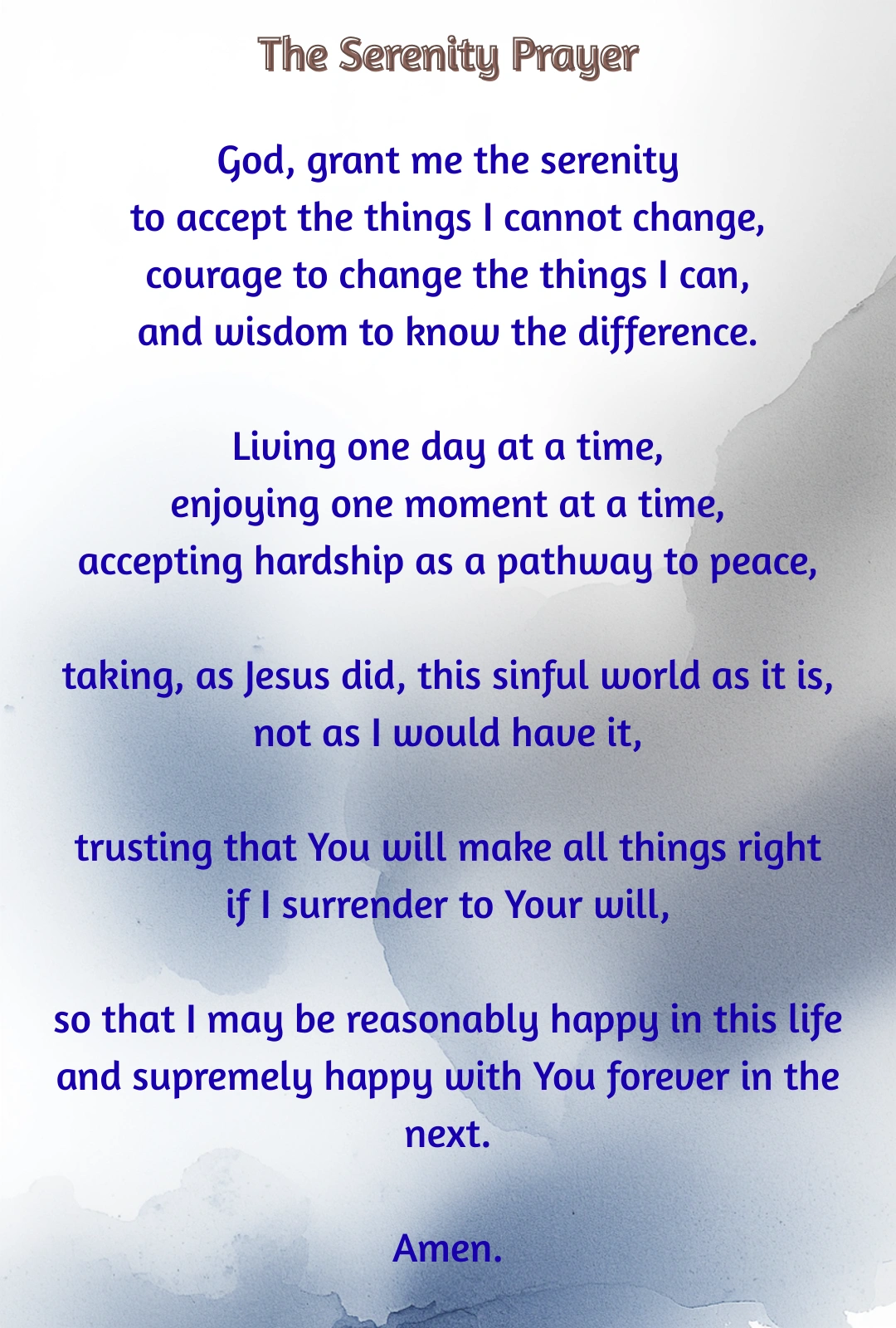
Meaning:
“Living one day at a time, enjoying one moment at a time” This pulls you out of anxiety about tomorrow or regret about yesterday. It asks you to be present now, where actual life happens.
“Accepting hardship as a pathway to peace” Suffering isn’t meaningless. When you stop fighting against unavoidable pain, you often find unexpected growth and calm on the other side.
“Taking, as Jesus did, this sinful world as it is, not as I would have it” This is about releasing the exhausting demand that reality match your preferences. The world is broken, people fail, injustice exists. Acceptance doesn’t mean approval it means working with what’s actually true instead of what should be true.
“Trusting that You will make all things right if I surrender to Your will” This requires faith that a larger plan exists beyond what you can see. Surrender here doesn’t mean passivity it means aligning your efforts with something greater than yourself.
“So that I may be reasonably happy in this life and supremely happy with You forever in the next” Notice it says “reasonably” happy, not perfectly happy. This prayer is realistic about earthly life while pointing toward eternal hope.
Read Also: St Dymphna Novena
Origin and Etymology of the Serenity Prayer
Historical Background:
The Serenity Prayer was composed by Reinhold Niebuhr, an American theologian and ethicist, sometime between 1932 and 1943. Niebuhr was a professor at Union Theological Seminary in New York and a prominent voice in Christian ethics during the 20th century.
The prayer first gained widespread attention when it was published in a 1944 obituary column. Alcoholics Anonymous adopted it in the late 1940s, and from there it spread rapidly through recovery communities worldwide. By the 1950s, it had become the most recognized prayer in addiction recovery circles.
Niebuhr himself was modest about the prayer’s authorship. When asked about it years later, he acknowledged writing it but couldn’t recall the exact date or occasion. Some scholars have debated whether earlier similar prayers existed, but Niebuhr is widely credited as the primary author of the version we know today.
Etymology Breakdown:
Serenity – From Latin serenus, meaning “clear, calm, peaceful.” The word carries connotations of clear skies after a storm, suggesting inner calm that comes after turmoil passes.
Courage – From Latin cor, meaning “heart.” Originally meant “to speak one’s mind by telling all one’s heart.” It evolved to mean bravery and the heart-strength to face difficulty.
Wisdom – From Old English wisdōm, combining “wise” and the suffix “-dom” (judgment, condition). It means practical judgment that goes beyond mere knowledge knowing what to do with what you know.
Accept – From Latin acceptare, meaning “to take what is offered.” Not passive resignation, but active receiving of reality as it stands.
Benefits of Praying the Serenity Prayer
Mental and Emotional Benefits:
Reduces anxiety by helping you release control over unchangeable circumstances. When you stop mentally fighting reality, stress hormones decrease and mental clarity improves.
Breaks the paralysis of overthinking. Many people freeze when facing problems because they can’t separate what they can influence from what they can’t. This prayer provides a decision-making framework.
Builds emotional resilience. Regular recitation trains your mind to pause before reacting, creating space between stimulus and response.
Combats the illusion of total control. Modern culture tells you that everything is fixable if you just try harder. This prayer offers permission to be human and limited.
Spiritual Benefits:
Deepens trust in a higher power. For believers, this prayer shifts the burden from your shoulders to God’s, reducing the crushing weight of trying to manage everything alone.
Cultivates humility. Accepting that you cannot change everything requires admitting you’re not all-powerful a healthy spiritual practice.
Encourages present-moment awareness. The long version specifically asks for the ability to live one day at a time, which aligns with many contemplative spiritual practices.
Practical Daily Benefits:
Improves relationships. When you accept that you cannot change other people, you stop trying to control them and start responding to who they actually are.
Supports recovery from addiction. Millions credit this prayer with helping them stay sober by focusing on what’s actually within their power their own choices today.
Enhances decision-making. The wisdom portion trains you to assess situations more clearly before acting.
Provides portable comfort. Unlike elaborate rituals, you can pray this anywhere no tools, no special conditions required.
How to Recite the Serenity Prayer
Basic Recitation Process:
Choose your version. Decide whether to use the short version (first four lines) or the long version. Beginners often start with the short version and add the longer form as it becomes familiar.
Set your posture. You can pray this anywhere, but intentional posture helps focus your mind:
- Sitting quietly with hands folded or open
- Standing with eyes closed
- Walking slowly, matching the rhythm to your steps
- Lying down before sleep
Speak it slowly. Don’t rush. Each phrase deserves weight. Pause between lines to let the meaning sink in.
Personalize when needed. Some days, one specific line will resonate more than others. It’s acceptable to repeat that line several times if it addresses your current struggle.
Daily Practice Suggestions:
Morning recitation – Pray it upon waking to set your mental framework for the day ahead. Speak it before your feet hit the floor.
Crisis moments – When stress spikes during the day, step away for 60 seconds and recite it slowly. This interrupts the panic response and reorients your thinking.
Evening reflection – Before bed, pray it while reviewing your day. Notice where you successfully accepted the unchangeable and where you found courage to act.
Group recitation – In recovery meetings or prayer groups, speaking it together creates communal strength. The unified voices reinforce shared commitment.
Written practice – Copy the prayer by hand in a journal. Writing slows your mind and deepens retention. Some people write it daily for 30 days to internalize it fully.
Breath-synchronized method:
- Breathe in: “God, grant me the serenity”
- Breathe out: “to accept the things I cannot change”
- Breathe in: “the courage”
- Breathe out: “to change the things I can”
- Breathe in: “and the wisdom”
- Breathe out: “to know the difference”
Advanced Recitation Approaches:
Meditative repetition – Similar to contemplative prayer traditions, repeat the prayer multiple times (5-10 rounds), allowing different layers of meaning to surface with each recitation.
Application focus – After reciting, spend 2-3 minutes identifying one specific situation in your life where you need serenity, courage, or wisdom. Name it clearly.
Gratitude addition – Follow the prayer with specific thanks for areas where you’ve already experienced these gifts. “Thank you for giving me courage yesterday when I set that boundary.”
Scripture pairing – Some Christians pair this with related Bible passages like Philippians 4:6-7 (about anxiety and peace) or the Serenity Psalm (Psalm 46).
Important :
This prayer isn’t a magic formula. Its power comes through consistent practice over time, allowing these truths to reshape how you think and respond to life. The first hundred times you pray it, you’re training your mind. After that, it starts training your heart.
Conclusion
You’ve seen how the serenity prayer addresses real human struggle. These words won’t magically solve problems, but they offer something better: clarity when emotions run high, and strength when you want to give up.
The power is in its simplicity. Speak it in traffic, before difficult conversations, or at 3 AM when worry takes over. No special setting needed. Just you and these words.
Return to this prayer whenever you need grounding. Say it slowly. Notice which part speaks loudest today that’s where you need support most.
Thank you for visiting BlessingRead.com. Come back whenever you need these words. We add new prayers regularly because everyone deserves access to peace.
Your next hard moment will come now you have something steady to hold onto.
? FAQs About Serenity Prayer
What is the Serenity Prayer?
A prayer written by theologian Reinhold Niebuhr in the 1930s-40s asking God for serenity to accept what you can’t change, courage to change what you can, and wisdom to know the difference.
Is the Serenity Prayer in the Bible?
No. Reinhold Niebuhr wrote it in the 20th century. While it reflects biblical wisdom, these exact words don’t appear in scripture.
What is the full version of the Serenity Prayer?
The full version continues beyond the famous opening, adding: “Living one day at a time, enjoying one moment at a time, accepting hardship as a pathway to peace…” and ends with requests for surrender to God’s will and eternal happiness.
Why is it used in AA and recovery programs?
Because it captures the core of recovery accepting powerlessness over addiction while taking courageous action on what you can control today. It helps people focus on their actual choices rather than fighting unchangeable realities.
How do you pray the Serenity Prayer?
Recite it slowly, either aloud or silently. You can pray it sitting, standing, or walking morning, during stress, or at night. There’s no single correct way. The key is speaking it slowly enough to absorb the meaning.
