
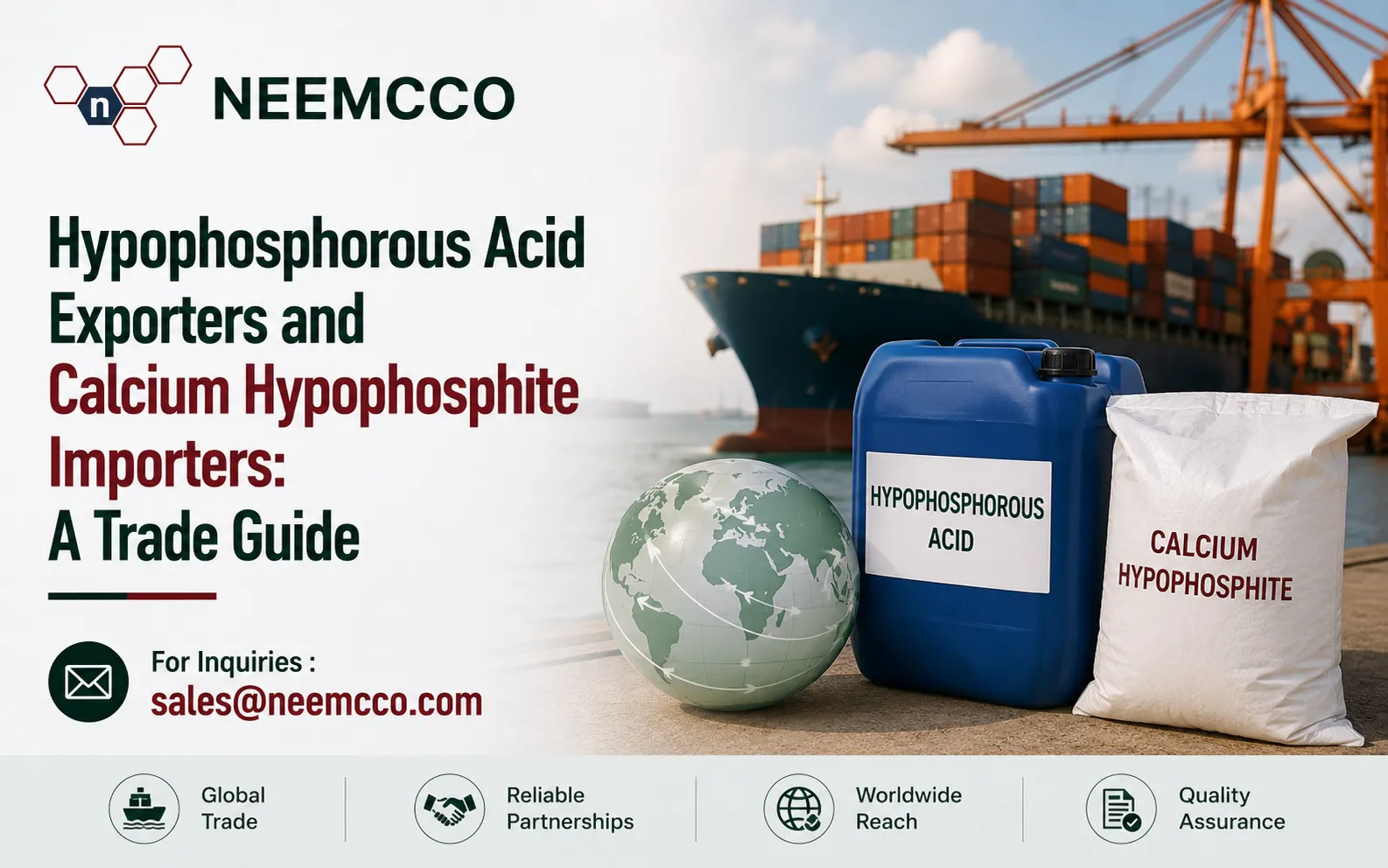
International chemical trade requires careful coordination between suppliers, buyers, logistics companies and customs agents. Businesses working with Hypophosphorous Acid exporters and Calcium Hypophosphite importers should confirm product details, documents and delivery terms before shipment.
Working With Hypophosphorous Acid Exporters
Hypophosphorous Acid exporters should clearly state the product name, chemical formula, CAS number, concentration, packaging and batch details. Hypophosphorous Acid is available in different grades, including 30%, 50% and 80% concentrations. The importer must mention the required concentration in the purchase order.
The exporter should provide a batch-specific Certificate of Analysis. This document helps the importer confirm the concentration, appearance and impurity limits. Depending on the final use, the buyer may need information about iron, chloride, sulphate, arsenic, lead and phosphorous acid.
The Safety Data Sheet is also necessary. It explains product hazards, storage conditions, protective equipment, emergency steps and transport information. The importer should share the SDS with the warehouse team, production department and freight forwarder before the cargo arrives.
Reliable Hypophosphorous Acid exporters should provide information covering concentration options, packaging formats, product specifications and SDS/COA support.
Responsibilities of Calcium Hypophosphite Importers
Calcium Hypophosphite importers should confirm the product grade, purity, packing and intended application. Calcium Hypophosphite is supplied as a white crystalline powder and is used in pharmaceutical, veterinary, nutraceutical, plastic and speciality chemical applications.
The importer should check whether the packaging is strong enough for international transport. HDPE bags are commonly used for this product. The packaging should protect the powder from moisture, contamination and physical damage during loading, shipping and storage.
The product label should include the product name, batch number, net weight, manufacturing date and storage instructions. Missing or unclear labels can create problems during customs clearance and warehouse receipt.
Professional Calcium Hypophosphite importers should verify purity, water solubility and batch-wise documentation before accepting the shipment.
Planning the Shipment
Before dispatch, both parties should agree on the Incoterm, port of loading, destination port, insurance responsibility and delivery timeline. The importer should confirm the HS code with a customs broker because classification requirements may differ by country.
Local regulations should also be checked. Some destinations may require chemical registration, import permits, special labelling or additional declarations. The receiving warehouse must be suitable for storing the product.
The purchase order should mention grade, quantity, packing, documents, delivery terms and acceptance criteria. Clear written communication reduces clearance delays and prevents confusion between the exporter, importer and logistics provider.
Importers should prepare the receiving site before delivery. The warehouse must have suitable space, compatible handling equipment and access to the SDS. Staff should know whether the shipment contains a liquid or powder and should understand the required personal protective equipment.
It is also wise to plan for delays. Buyers should maintain reasonable stock and confirm the expected transit time with the freight forwarder. If the material is needed for continuous production, a clear reorder point can prevent a shortage while a new shipment is in transit.
The importer should keep copies of all shipping and quality documents for future audits, repeat orders and customs queries.
